Showing posts with label Central America. Show all posts

Wednesday, December 28, 2011

To Vaccinate or Not??

Looks kind of scary doesn't it?

We have traveled outside of the United States many times on vacation. Only once did we have to take medication or have vaccines, that was when we traveled to Peru in South America. Since this time it will be a little more than a vacation, and we will actually be moving to Belize, our doctor recommended we check out the CDC (The Centers for Disease Control and Prevention) for guidelines for anyone traveling or living in foreign countries. So we sat down with our doctor in his office and he pulled up the CDC web site and gave us a list of the recommended vaccines we should consider. We plan on traveling throughout Central America, South America, Mexico and the Caribbean, so we thought that the pain of taking a few pricks to the arm would be worth it. 

Now I absolutely hate getting shots. I mean really who doesn't?? Just thinking about taking some shots to the arm was causing my anxiety level to go up. Our doctor said we should go to our local health department because the vaccines would be a lot cheaper than he could give them to us. You should receive these vaccines 4 to 6 weeks before travel to be fully protected from these diseases. We were already running out of time and Hep vaccines require several trips to the doctor for a series of shots. According to my doctor the CDC recommended TDAP, Hep A, Hep B, Typhoid and Rabies.

Hepatitis A - Hepatitis A is transmitted through contaminated food and water.

Typhoid Fever -  Typhoid fever is a bacterial infection. It occurs worldwide and is transmitted by contaminated food.

Hepatitis B - Hepatitis B is a viral illness transmitted through blood products, contaminated medical instruments. 

Rabies - Rabies is transmitted by a bite or scratch from rabid infected animal.

DTAP - DTAP vaccine protects from diphtheria, tetanus (lockjaw), and pertussis (whooping cough).


Bill getting his second series of Hep.

I am happy to report that the shots didn't hurt at all. We obviously had a nurse with lots of experience and a good aim. She said our arms would be sore and we should take ibuprofen for the next two days afterwards. My arm never got sore, not even once.

My doctor was right, the vaccines were pretty pricey. We have spent $436.00 for both of us so far going through our local health department and we have one more series of Hep to go. We are also taking the accelerated version of the Hep vaccine over a 4 week period of time instead of the normal 6 months. We opted out of getting the Rabies shots. Just one series was almost $200 each. We decided we would just take our chances on it and hope we don't run into a rabid animal. As one friend said the other day, these things are just a small price to pay to live in paradise. I think I agree.

Moving or visting a foreign country, do you plan on getting the recommended vaccines?

Friday, December 23, 2011

We Are Officially Retired


Retirement, according to Wikipedia is the point where a person stops employment. December 1st, 2011 Bill officially retired from Gray-Daniels Ford after 17 years. I had been a realtor with Century 21 Maselle since 1998 and I loved my job. But yes, we did it, we actually quit our jobs and stopped working. You would think we would be jumping up and down and celebrating. Well the strange thing is, we haven't had time to feel retired yet. With the holidays upon us and so much to do before we move to Belize, our real official retirement will have to wait a few more weeks. 


We sold our home in October, all of our furniture and most all of our personal things and moved in with my father. I had spent hours, months, years shopping and collecting things from all over the world. 28 years worth of stuff, most all of which was gone in a matter of a few weeks. Did I get upset? Well again, I really have not had time to think about it all. It has been happening so fast. We are just focused on the the real thing we are looking forward to in our retirement, a much simpler life and time to spend together.  Yep, that's it folks, it is just that simple.  That is all we really want at this point in our life and while it might be a simple life, it will never be a boring life. 

When you retire, what kind of life will you be looking for?

Thursday, August 4, 2011

Weather in Belize - August


The month of August is locally referred to as the "Little Dry". Rainfall starts to decrease and the easterly winds are beginning to die down. August temperatures range from an average low of 78.0 degrees to an average high of 86.0 degrees.

Thursday, June 30, 2011

10 Reasons Why You Will Love Retiring in Belize


  1. Sub-tropical climate - Belize has a sub-tropical year round climate where frosts and freezes are unknown.
  2. Hol Chan Marine Reserve - Hol Chan is a national park that includes part of the barrier reef.
  3. Shark Ray Alley - Belize is one of the best places to get up close and personal with sharks and stingrays.
  4. The Barrier Reef - The Belize Barrier Reef is the largest in the western hemisphere and is 190 miles long.
  5. The Howler Monkey – Belize has a rare breed of howler monkey that is known as one of the top ten loudest animals in the world.
  6. Mayan Ruins - Belize has a rich Mayan history with over 900 historic locations.
  7. The People – Belize is home to some of the most interesting and friendliest people who are very accepting of other cultures.
  8. The Jungles – 60% of Belize is forested, hiking through the jungles is an amazing experience.
  9. The Caribbean Sea – The waters off of Belize are known to inhabit more than 400 species of sub tropical fish.
  10.  BELIKIN BEER – “The Only Beer Worth Drinking”
Photo:  AJ Baxter, Picture Belize

Wednesday, June 22, 2011

Photo of the Week - The Belize Great Egret (Casmerodius albus)


The great egret is a slender and graceful heron with a wingspan of 36 inches.  It lives in the coastal lagoons and marshes. 
It feeds in the shallow waters of Belize and preys on fish and reptiles. During the drier months the bird will prey on small mammals and nesting birds.
Photo: A.J. Baxter, Picture Belize

Wednesday, May 18, 2011

Photo of the Week - The Iguana


You will find the Iguana everywhere in Belize. The two kinds of iguanas found in Belize are the Green Iguana and the Wish-willy. The iguanas in Belize eat mostly plants like berries, fruits and leaves. 

Monday, May 16, 2011

Crime and Personal Safety in Belize


It is easy to talk about all the wonderful things I love about Belize, what’s not to love about the beautiful turquoise blue green waters, the lush green jungles or the ancient Maya ruins. But like any place, there is crime and Belize is no different. 

It would be difficult to compare crime statistics from one country to another because of different record keeping and recording systems. The murder rate in Belize for 2008 was reported to be 34.2; which means for every one hundred thousand citizens, 34 were victims of murder in 2008. Compare this to the United States in 2008 where there were 5.4 murders per 100,000 people.

Most serious crimes in Belize are primarily connected to drugs. While there are gangs in Belize City, it is nothing like those compared to other Central American countries.

Although Americans are not specifically targets of crime, you should always exercise caution where ever you travel throughout the country. The majority of reported incidents are in Belize City, but crimes may occur anywhere including tourist destinations. Statistics suggest that the crimes are concentrated among the native lower classes, not aimed at travelers. 

The last time I was in Belize, I spoke to a woman that has lived in Belize for over 6 years. She told me that she had been robbed several times and had her purse stolen.  My first thought was to be very scared. She then told me that all of the incidents were her own fault. She said she had been out late, by herself and had been drinking. She was never harmed, but these types of situation you should always avoid, especially females.

Travel Safety Tips
Travel in groups during daylight hours and do not walk in unlit areas at night.
Avoid wearing flashy jewelry.
Do not carry expensive items.
Do not leave valuables unatteneded.
Woman should not carry large purses and keep purses zipped.
Men should carry their wallets in their front pockets.
Do not carry large sums of cash.
Carry cash in different places.
Do not pick up strangers in your car.

Most crimes that I have heard of in Belize are petty theft crimes. Someone left something unattended.  Shoes were left outside on the porch or they parked their bike and did not lock it up only to come back later to find them missing.

Burglar bars on homes in Belize are not always meant to keep out burglars. Many homes do not use air conditioning and therefore keep their windows open.  Burglar bars are used to keep animals out when the windows are open.

Tips for avoiding home theft and burglaries
I am told the best thing you can do is to get a dog. I think this is true no matter where you live.
Have a fence or wall around your property.
Install an alarm system or burglar bars.
Install exterior lighting around your home.
Get involved with your neighborhood watch program. Yes they have these in Belize.

Someone emailed me a few weeks ago and asked me "if I felt safe in Belize and if there were areas in Belize where I would not go"? I told him "I probably would not be in Belize City after dark". But I also told him where I live, drive 20 minutes and there are certain areas "I would not go day or night either, because I know they carry guns there". I have never felt anything but safe when in Belize and in talking to most expats and retirees living in Belize they expressed little concern about their safety and were happy with their decision to move to Belize.

Photo: Oracio Alvarado, Flickr

Thursday, April 28, 2011

Belize Travel Information


Getting to Belize
Belize City is approximately a 2 hour flight to Houston, Texas. Many international airlines service Belize on a daily basis and fly into Phillip SW Goldson International Airport (BZE) located 9 miles outside of the city. Most airlines in the United States connect through Miami, Dallas, Houston and Los Angeles.
Tropic Air and Maya Air are the main local carriers and offer connecting flights almost every hour to most of Belize's major towns and resorts. Keep in mind that they do not fly at night.

Entry Requirements to Belize
Adults and children require a valid passport for at least 3 months after the date of arrival and a return ticket to enter Belize. US citizens do not require visas if they have a passport and return ticket. You can stay in Belize as a visitor up to one month and must get an extension after 30 days.

Time in Belize
Belize is in the Central Standard time zone the same as the United States. Belize does not observe Daylight Savings time.

Belize Currency
The Belizean dollar is the country's official currency but most US visitors use US dollars which are fixed to the Belizean dollar at a rate of approximately BZ$2 to US$1. Most tourist areas accept major credit cards, just note that the transactions fees can be expensive. You will find ATM's throughout the city but most are for the local banks. U.S. dollars are accepted everywhere in Belize.

Departure Taxes and Fees
Departure taxes that use to be collected at the airport are now included in the cost of most airline tickets. 
If you are departing the country through land borders you will be required to pay a border exit fee of US$18 per person. There is a standard 9% hotel tax. A 9% sales tax is charged on most goods and services in the country.

Belize Weather
The hurricane season normally runs from June to November.

Prohibited ExportsPre-Columbian articles, marine products, unprocessed coral or turtle shells.

Safety Tips
According to TravelBelize.org you should follow certain basic safety tips.
  • Keep your travel plans, including accommodation details, to yourself.
  • Only make reservations with tour operators who are licensed. Ask them for a direct contact in cases of emergency.
  • Don't hitch hike.
  • Try not to travel at night.
  • Avoid quieter areas of the cities you visit, especially at night.
  • Ask your hotel manager for advice on 'safe' versus 'unsafe' local areas.
  • As a general rule, city streets that include children and women suggest the area is safe for families.
  • Carry with you at all times the contact details of your home country embassy click here for embassy listing in Belize. If your country doesn't have local embassy, find out which other country's embassy is available to help you, such as the British or US embassy.
  • Keep a photocopy of your passport and all other important documents in a safe place.
  • Use ATMs during the day, when there are people around.
  • Try to rely more on credit cards and travelers checks than cash.
  • If you are mugged, don't fight back. It is better to lose a few dollars and a wristwatch than get injured.
  • Avoid incidents such as fights, riots or civil disturbances at all times.
  • Report all incidents to the Belize police department nearest to you.

Tuesday, April 19, 2011

Speaking Belizean Kriol

English is the official language of Belize, but Creole English or Kriol serves as the main spoken tongue among and between groups. You will find quite a bit of Spanish spoken throughout Belize due to the immigrates from Central America. 

To speak Kriol, listen to the spoken language. If you can't understand what they are saying, ask the person to slow down and explain the phrases to you. You may find that writing the words or phrases down and repeating them over and over is the best way to learn some of the language. 

It would probably be a good idea to learn a few words or phases in Kriol, just for kicks and giggles. Also, it's a great way to make new friends in Belize. 

Here are a few words and phrases to get you started:
"Right Now" means "Just a moment"
Aarait - Fine, thanks you.
Haul your rass! - Get the hell out of here!
Stap u rass! - Shut your mouth; stop your foolishness.
Kohn ya! - Come here!
Weh yu nayhn? - What is your name?
Ah nayhn - My name is
Gud maanin - Good morning.
Weh taim yu gat? - What time is it?
Shuck your corn. - Have sex with, as in "I wan shuck your corn." Synonym: " Flip your gizzard."
How much pikni yu got? - How many children do you have?
Mutha fry check. - Idiot.
Jook. - To have sex.
Dat okay. - It's okay.


Photo: Gracey, Morguefile.com

Monday, April 18, 2011

Where to Live in Belize? Punta Gorda and Southern Belize


This week on "Where to Live in Belize?", we are looking at Punta Gorda and the Toledo District.  I know you have heard stories about Punta Gorda being the end of the earth, but PG does have some hidden gems to be discovered. 

Punta Gorda, known locally as PG, is the town of the Toledo District in southern Belize. PG is a colorful and friendly town with a population of about 6,000 people. Although Punta Gorda is a Spanish name, its inhabitants are mostly Kriol/English speaking, primarily of Garifuna, East Indian, and Kriol descent.
Punta Gorda is 210 Miles by road from Belize City. The road into town follows the shoreline. There are five streets that run parallel inland. Fruit trees line the streets. Most small homes are made of wood on stilts.

Punta Gorda is putting the Toledo area on the map as the "Unforgettable" corner of Belize, rather then the "Forgotten" corner. The majority of Toledo District's attractions are found in the form of remote villages, caves, waterfalls and offshore cayes. Looking for something off the beaten path, then this area is worth checking out.

PG has a small airport which serves domestic flights from Maya Island Air and Tropic Air. James Bus line is based in Punta Gorda and offers a regular service to Independence, Dangriga, Belmopan, and Belize City. Water taxis offer daily service to Livingston, Puerto Barrios, and Guatemala. Punta Gorda is a gateway to and from Guatemala with immigration and customs office located near the town dock.

Wednesdays and Saturdays are the biggest market days. Mayan vendors sell wild coriander, yellow or white corn, chili peppers, tamales wrapped in banana leaves, star fruit, mangoes and much more. The woman and children bring handmade crafts to sell at market.

Reasons to Live in Punta Gorda and Southern Belize

1. Diverse mix of Maya, Garifuna and other cultures.
2. Excellent Fishing.
3. Beautiful, lush tropical areas.
4. Increasing interest in area for tourism due to completion of Southern Highway.
5. Land is reasonable priced.
6. Close to Guatemala.
7.  Seeking a quiet area in Belize to live.

Wednesday, April 13, 2011

Where to Live in Belize? Dangriga and Hopkins Area

Dangriga

Dangriga is off the coast approximately 36 miles from Belize City and is the hub of this area.  Shopping and medical facilities are located in Dangriga, Hopkins has only a few small shops. 

Dangriga is not as popular with the expats as the Hopkins area which is slowly attracting more expats seeking beachfront property.

Hopkins does not have an airstrip, but you can fly into Dangriga.  There is also bus service available between Dangriga and Hopkins.  Dangriga is about 15 miles from the Hopkins area down the Southern Highway.  Expats will probably want to have a car living in this area.


Reasons to live in the Dangriga/Hopkins Area

1.  Friendly, funky, small village
2.  You still have close access to the barrier reef.  It is only about 12 to 15 miles off the shore.
3.  Water sports available such as fishing, boating, snorkeling and diving.
4.  Hopkins has real beaches.
5.  Considered the most exotic area of Belize.
6.  Lower prices for beachfront property.
7.  Fascinating history of the Garifuna (pronounced Gah-RIF-oo-na) people.
8.  Easy access to Cockscomb Jaguar Preserve and other natural areas of Belize.
9.  Only a short drive to the Maya ruins at Mayflower.
10. Cockscomb Basin Reserve, a real rain forest jungle.

Tuesday, March 8, 2011

Where to live in Belize? Corozal


Corozal is a popular spot for expats and is the Northern most town in Belize which means you would be extremely close to the town of Chetumal, Mexico.  Chetumal, Mexico offers medical services and more options for shopping which in include an American like mall and Sam's Warehouse shopping. 

The Corozal district is 718 square files in area.  Spanish is spoken more widely then English here, although you should easily be able to get by in English at least in Corozal Town.


Corozal town area offers low cost housing whether you are renting or buying, a sizable expat community and a pleasant location on the Bay of Chetumal, sometimes referred to as Corozal Bay.  There are few sand flies and pesky bugs in most areas.  Corozal has a pleasant sub-tropical climate with lower rainfall then southern Belize.  It is generally considered to be safe and friendly.  You have easy access by car, bus, water taxi and air to Ambergris Caye, other areas of Belize and the Yucatan.

Thursday, March 3, 2011

Belize Weather in March

March weather conditions in Belize are very similar to that of February. March falls within the dry season, and the typically rainy southern part of the country will see even less rain this month. Temperatures are on the rise to a balmy mid-80s and vacationers will enjoy the sun with little interference by a rain shower.

Typical Weather in March

On a typical March day, during the early morning hours you will probably find the temperature will be around 72.6 degrees. The temperature will rise over the course of the typical March day, reaching somewhere around 82.8 degrees by early afternoon. The temperature in Belize will typically decline by early evening, to approximately 78.5 degrees. Overall, temperatures in Belize during March average around 77.5 degrees.

Rain

Rain is most likely to occur around 12:00 AM (midnight) during the month of March, and it is least likely to occur around 3:00 PM . To the extent thunderstorms occur in Belize during March, they are most likely to occur around 12:00 AM (midnight) , as shown in the following table

Source:  Belize Guide

Wednesday, February 23, 2011

Where to Live in Belize? San Pedro, Ambergris Caye

Ambergris Caye, Belize

We have been to Belize several times and have stayed on both the mainland and on the islands.  Belize was not our first choice of where to retire, it was originally Key West, Florida.  But I was just never sold on the idea of retiring to Key West and we had never really considered the option that we could move to another country and retire.


Last year we starting reading and looking into Belize and after making another trip to Belize, this time just staying mainly on the island of Ambergris Caye in the town of San Pedro, Bill and I decided Belize is where we wanted to be.  We felt like Belize had the best of everything to offer, it has the islands, jungles, Mayan ruins, they spoke English, easy access to the US and we could afford to live there.  We thought, what more could we ask for?


Ambergris Caye is Belize's largest island in the Cayes and is the most popular destination in Belize, for expats and tourist.  It has the largest expat community with a resort island atmosphere.  Belize has the second largest coral reef system in the world.  The reef lies 1/2 mile east of the Ambergris Caye shoreline and runs the entire 25 miles length of the island.  This has made San Pedro Town the dive and water sports capital of Belize and Central America.  The Great Blue Hole, Turneffe Islands, Shark Ray Alley, Hol Chan, Marine Reserve, Mexico Rocks, and Lighthouse Reef are only a short boat ride away. 


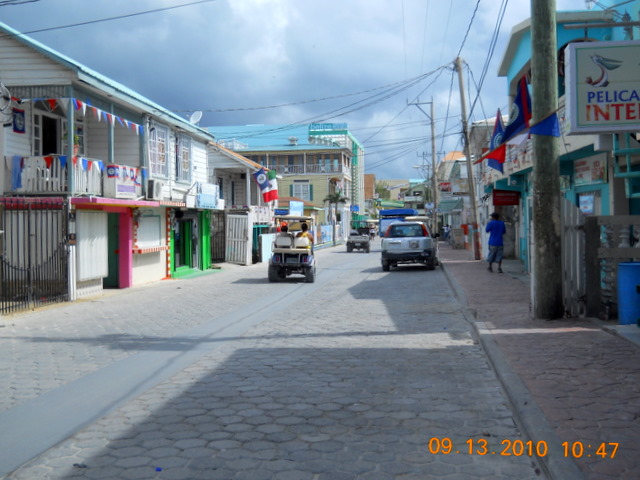
San Pedro reminds you of the Caribbean of 30 or 40 years ago, before the boom of international travel.  There are just three main north-south streets which are lined with wood houses and shops painted in bright tropical colors.  Most people get around town on foot, bike or golf cart.


Ambergris Caye has the sun and heat of the tropics, but is cooled by the trade winds off the Caribbean Sea.  Temperatures range from about 75-95 degrees during the day year round.  The rainy season is May to February, with most of the rain following in the late afternoon and evening.  Southern Belize may get up to 140 inches of rain a year, Ambergris Caye only gets about 40 inches per year.  The water temperature stays pretty much around 82 degrees year round.

Other post you may be interested in:
Where to Live in Belize?  Caye Caulker
Where to Live in Belize?  San Ignacio

Tuesday, February 22, 2011

Scorpions in Belize


If you are scared of Scorpions, Belize may not be the place for you.  Scorpions are found in 16 states of the US and are found through out all of Belize with 4 known species.  Scorpions actually do not bite, but they sting and are usually not life threatening.  The stinger is in the tail and the sting can be very painful. 

Scorpions are nocturnal and come out when the sun sets.  They love to find little corners or hidden away places to hide. 


We found one on the shower floor one morning when we were staying at the Maruba Jungle Spa in Belize.


Maruba Jungle Spa


Thursday, February 17, 2011

Photo of the Week - Snorkeling with Nurse Sharks in Belize

Nurse Sharks

One of the highlights of our last trip to Belize has to be the day we went snorkeling with the nurse sharks and string rays in "Shark Ray Alley" off the island of Ambergris Caye.  Getting to Shark Ray Alley is only a short boat ride from the island and you won't have a problem finding a guide on the island to take you there. 

Nurse Sharks are considered mainly non-aggressive but they have very powerful suckers rather than teeth, kind of like a catfish.  If they latch on to you it can be bad.

It can feel a bit intimidating sitting on the side of a boat about to jump in with these sharks, but it is well worth it.

Wednesday, February 16, 2011

Belize weather is characterized by two seasons: a rainy and a dry season


Belize is situated on the Caribbean coast of Central America with Mexico to the North and Guatemala to the west and south. It lies between 15º45´ and 18º30´N and 87º30´ and 89º15´W. The terrain is low and flat along coastal areas and in some northern regions of the country while in the central and southern regions low mountains rise gradually to a height of 3,685 feet.


Belize is hot and humid and the weather is characterized by two seasons: a rainy and a dry season. Belize annual rainfall: most of the year's rainfall occurs during the period June to November, that is, the rainy season. The transition from dry to the rainy is very sharp. Belize annual rainfall ranges from 60 inches in the north to 160 inches in the south. Except for the southern regions, the rainfall is variable from year to year.


The onset of the rainy season begins in the early May in Toledo, (where the Belize annual rainfall is highest) progressing north to the Stann Creek, Belize, Cayo and Orange Walk District in late May, followed by Corozal District in early June. The mean temperature varies from 81°F/ 27°C along the coast to 69°F/21°C in the hills. The coldest month is January while the highest temperatures are experienced during the month of May.

For more information about the weather in Belize, check out The Belize government National Meteorological Service site.

Tuesday, February 8, 2011

Tiny Belize: A Huge Country for Divers

fishy


If you know any avid divers who have been to Belize, do not ask them about it unless you have a few hours…you will not be able to shut them up.

Belize is in fact a tiny country, but not if you include the underwater wonderland that is adjacent to it. Then, at least in dive terms, it’s one of the largest countries in the world! Belize has everything you want in a tropical escape, but when it comes to the diving and the saltwater fly fishing, it is among the best in the world.

Though it’s probably smaller in total square miles of real estate than some counties in Texas, Belize offers more dive opportunities than you could possibly experience in a year.

With a bewildering array of big walls, barrier reef, open water atolls and islands, and plenty of sharks of all types, the fact is, diving just may be Belize’s biggest growth industry besides real estate. From coral gardens and stunning parrot fish to giant whale sharks, it’s all here, even for two-tank veteran divers who seek longer outings.

Unlike some Caribbean countries and most of Central America, you can dive year-round in Belize, right through the rainy season.

Tiny Belize: A Huge Country for Divers

Tuesday, February 1, 2011

Where to Live in Belize? Placencia


Placencia has some of the best beaches on the mainland and a growing expat community.  16 miles of  beaches located on a peninsula with the Caribbean Sea on one side and lagoon on the backside, about 120 miles south of Belize City..  You can snorkel here but for the best  snorkeling you will have to take a boat out to the reef or to one of the small offshore cayes, a 10 to 20 mile boat ride.


Land on the peninsula is low-lying and flat.  You can see the Mayan Mountains to the west. The average temperature in sub-tropical Placencia is 80 degrees Fahrenheit and the average humidity is 83%.  Generally the dry season and the most popular time to visit is January through May.  June, July, October and November are typically the rainiest months.  Rainstorms are usually short, but very powerful.


Most foreign residents choose Placencia for its low stress attitude.   The atmosphere is laid-back and focuses mainly on fishing, boating and other activities on the water.